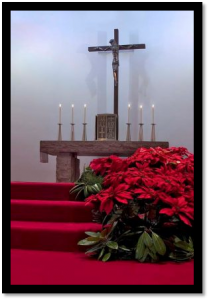
Here is the sermon preached at St Ann’s on Epiphany I, the 13th of January 2013.
For as we have many members in one body, and all members have not the same office : so we, being many, are one body in Christ, and every one members one of another.
In the name of the Father, and of the Son, and of the Holy Ghost. Amen.
Hear the voice of the Nineteenth Century, crying not into the wilderness, but into the very midst of the storm :
Out of the night that covers me,
Black as the Pit from pole to pole,
I thank whatever gods may be
For my unconquerable soul.
In the fell clutch of circumstance
I have not winched nor cried aloud
Under the bludgeoning of chance
My head is bloody, but unbowed.
Beyond the place of wrath and tears
Looms but the horror of the shade
And yet the menace of the years
Finds, and shall find, me unafraid.
It matters not how straight the gate,
How charged with punishment the scroll,
I am the master of my fate;
I am the captain of my soul.
Very Captain Ahab, isn’t it? Thus spake William Ernest Henly, who lived from 1849 to 1903. The title of the poem is “Invictus.” The title is Latin, and translates as “Unconquered,” or “Unbowed”. Henly was a true product of the nineteenth century, and the poem encapsulates vividly the individualist mindset which permeates–one might even say, infects–Western culture in our era. Timothy McVeigh, the misguided young conspiracy theorist and would-be revolutionary who was executed for the 1995 Oklahoma City bombing, recited this very poem when he was asked for a final statement before his execution.
The sentiment of this poem should be familiar to all of us. For it articulates principles which resonate deeply with the American experience : the push westward of the pioneers against a hostile landscape, inimical elements, and economic hardship. They became self-reliant because, in many cases, there was no-one else to rely upon. And the habits of self-reliance, once learned, are difficult to break. This is one reason, I think, why the nuclear family rather than the extended family has become the normal social unit in our culture. Often the nuclear family was all that there was on the frontier. And even religion was affected : the stability of a diocesan structure, with episcopal oversight and the sense of belonging to a wider Christian community, was unknown to most early Americans. The result is that Catholic Christianity is something of a late-comer on the American scene, and that creeping Congregationalism has influenced even the more hierarchically constructed churches–look at the vestry system in the Episcopal Church for one example.
Think again, though, on what St Paul says in today’s Epistle. He is, tradition holds, speaking to the church in Rome. In today’s extract he counsels them to turn their back on “the world”–not meaning necessarily that they should all become hermits and misanthropes, of course. In Paul’s writing, he often uses “the world” to mean those who are not practicing the Christian faith–in other worlds, the secular culture which surrounds us and in which we must move, live, and conduct our affairs. Like our modern culture, the aims and norms of Roman culture were quite divergent from those of the Christian faith : divorce and sexual immorality were rampant, greed and graft had corrupted the government, and the poor were brutally oppressed by the rich. Sound familiar? Well, it should; it’s the same old situation the human race is always in. We Christians have an explanation for it, of course–it’s a product of the fallen world. The world is not in itself evil, but has degenerated to this evil state as a result of the sin of humanity. We Christians also know that there is a remedy for this : that our Lord became a human being, endured our sufferings, and submitted to an ignoble death in order to redeem us. We have to take individual action in order for this redemption to benefit us; in this sense salvation is an individual concern. Other people cannot save us; only God saves, and we each have to make our personal response to God in order for that salvation to work.
So Paul continues to tell us to be careful that we not think of ourselves too highly, or to overestimate our own worth. Here he’s not warning against pride, per se (although that’s certainly always something to watch out for) : this is preparatory to his main point, which is that we are all members–organs, limbs–of one body. We, the church, are one body in Christ. In fact, elsewhere he refers to the church explicitly as the Body of Christ. In either case, the point is the same. We are all interdependent and none of us can exist effectively on our own. For example : I am a priest. Some might say that makes me a very important person indeed. And certainly, there are some things that just cannot happen without a priest–the Eucharist or absolution, to name two. In that sense, a priest is special, but the “specialness” extends only to his office, his function. Being a priest doesn’t make me better than anyone else; it means that I have a different job to do than most of you. Similarly, the eye isn’t “better” than the elbow; it has a different function. Although at first thought it might seem that the eye is more important (after all, if you can’t see, your overall functioning is impaired), if you think about it for a while you’ll realize that without the ability to bend your arm your ability to reach for things, grasp things, and manipulate things is greatly impaired. So although the elbow might seem more humble than the eye, in reality our body needs both of them to function as it’s supposed to.
Neither eyes nor elbows exist in a vacuum; they need each other, and the rest of the body, to do what they’re supposed to do. And as people, we don’t exist in a vacuum either. There are lots of reasons why any of us might have wound up here at St Ann’s : some are cradle Episcopalians, or cradle Catholics who feel their church has gone further away from God rather than closer to Him. Some respond to the traditional hymnody and music, or to the liturgy, or the sonorous language of the King James Version and the 1928 Prayer Book. But above and beyond these things, it’s our fellow Christians who keep us steadfast in the faith, no matter what church we may belong to. It’s our brothers and sisters in Christ who are here to encourage and to rebuke, to rejoice or commiserate in our happiness or sorrow, and to act as mentors and companions in our journey. We cannot do it alone. We were never intended to do it alone. We are all members of one body.
I’m sure we’ve all heard, at a cocktail party, wedding, or some other social occasion, someone loudly proclaiming his respect for Jesus and his “teachings” while saying that he has no time for religion–after all, the churches are just full of hypocrites, and he can worship God just fine on his own while fishing on a peaceful mountain lake. This is, of course, absolute nonsense. You can, it’s true, get a sense of God’s greatness by contemplating the grandeur of his creation. If you’ve reached an appropriate stage of spiritual development, God can speak to you in the stillness of an early morning in the mountains. But there is simply no substitute for worshiping God together with other worshipers in spirit and truth, with our hearts and minds, our bodies and voices; much less is there a substitute for receiving the very substance of God in the Eucharist. I suspect that part of that disgust for hypocrisy involves what Carl Jung, the famous psychological theorist, would have called a “shadow projection”–the desire to avoid, by projecting upon others, the less savory aspects of one’s own personality. And so the charge of hypocrites in the churches can only be answered in the words of another Karl, the late Bishop Karl Bloch of California : “There’s always room for one more.”
Soon, we will begin our preparation for Lent. The Blessed Apostle will then speak to us of the race we are set to run. But this race, unlike others, is not one in which the winner takes all. Everyone who finishes is a winner; the only ones who lose are those who give up. And since it’s not a zero-sum game, we can’t benefit from the misfortunes or mistakes of others–in fact, we are bound, in order to finish the race, to help one another through those misfortunes and to gently correct one another on the way to the finish line; the eye doesn’t suffer as a consequence of guiding the hand, nor do the legs suffer as a consequence of propelling the body in the direction of the food which benefits the whole. We are members of Christ’s body, and not isolated individuals; the whole body, and not just one or two isolated parts, must finish the race. May we keep these excellent words of St Paul in our minds today and always, until in triumph we finally realize our destiny : to glorify God and enjoy Him forever.
In the name of the Father, and of the Son, and of the Holy Ghost. Amen.